






Bulletin of the Geological Survey of Japan Top Page
Bulletin of the Geological Survey of Japan Vol.77 No.5 (2026)
Cover photograph | Table of Contents | Abstract
Cover Figure
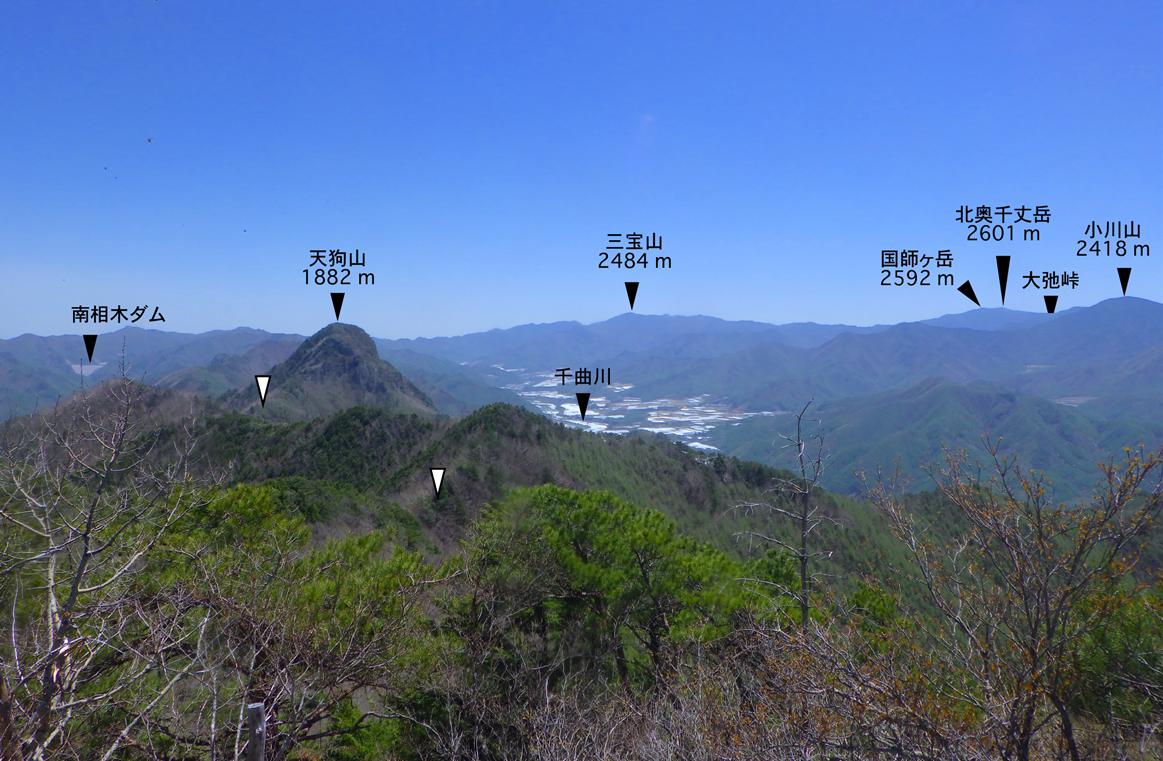
Upper Chikuma River valley and the Okuchichibu Mountains viewed west-southwestward from near the summit of Mt. Otokoyama
Miocene granitoids intruding Jurassic–Cretaceous accretionary complexes are widely distributed along the main ridge of the Okuchichibu Mountains, where elevations reach 2,000–2,600 m, and on the northwestern flank of the mountains. The Omiyama pluton (13.5 Ma) extends across the ridge between Mt. Otoko and Mt. Tengu, which marks the boundary between Kawakami and Minamiaiki villages in Minamisaku District, Nagano Prefecture. The contact between the pluton and host rocks is exposed at the locations indicated by white arrowheads in the figure. The Sanpo pluton (13.8 Ma) is exposed between Mt. Kitaokusenjo and Mt. Sanpo, and its intrusive contact with the Mizugaki pluton (15.0 Ma) is located near Odarumi Pass. For details on the ages of these granitoids, see Yamaoka and Murakami (2026) in this issue.
(Photograph and Caption by YAMAOKA Ken)
Table of Contents
All the pages PDF : 77_05_full.pdf [11MB]
| Title | Author | |
|---|---|---|
| Article | ||
| Magnetic polarity and rock-magnetic properties of the uppermost part of the lacustrine Pleistocene Tsukidate Formation in the northwestern Mukaimachi Caldera, northeast Japan | HANEDA Yuki, SHIBASAKI Tatsuya, SATOGUCHI Yasufumi, SUGANUMA Yusuke, HOSOI Jun and YAGI Hiroshi (p.195-212) | 77_05_01.pdf [4.7MB] |
| Report | ||
| Timing of emplacement of middle Miocene plutonic rocks in the Kinpusan area, Kanto Mountains, central Japan | YAMAOKA Ken and MURAKAMI Daichi (p.213-225) | 77_05_02.pdf [4.5MB] |
Abstract
Magnetic polarity and rock-magnetic properties of the uppermost part of the lacustrine Pleistocene Tsukidate Formation in the northwestern Mukaimachi Caldera, northeast Japan
HANEDA Yuki, SHIBASAKI Tatsuya, SATOGUCHI Yasufumi, SUGANUMA Yusuke, HOSOI Jun and YAGI Hiroshi
The Mukaimachi Caldera, located in the southern part of the Kurikoma geothermal area in northeast Japan, is filled by Pleistocene lacustrine deposits. However, it remains unclear whether these deposits preserve stable remanence, given the lack of previous paleomagnetic surveys in the area. In this study, we conducted paleomagnetic and rock-magnetic measurements of the uppermost part of the lacustrine Tsukidate Formation in the northwestern Mukaimachi Caldera to identify its magnetic polarity and rock-magnetic properties. Progressive demagnetization experiments and remanence measurements show that mudstones of the uppermost Tsukidate Formation have a primary and stable remanence that is removed by heating to 690 ℃. The thermomagnetic curve, coercivity–interaction field distribution, and coercivity spectra suggest that this primary remanence is carried by magnetite and hematite in singledomain to pseudo-single-domain states. The paleomagnetic directions calculated from the primary remanence, together with previously reported tephra correlations and K–Ar ages of the Myojin-yama Andesite, which intrudes the Hitohane Formation that overlies the Tsukidate Formation, indicate that mudstones located below and above a tuffaceous gravel bed in the uppermost Tsukidate Formation correspond to the Matuyama Reversed Chronozone and Brunhes Normal Chronozone, respectively. Further work is required to clarify the timing and mechanism of the acquisition of the hematite-carried remanent magnetization.
Timing of emplacement of middle Miocene plutonic rocks in the Kinpusan area, Kanto Mountains, central Japan
YAMAOKA Ken and MURAKAMI Daichi
We conducted U–Pb zircon dating of granodiorite samples collected from the Sanpo and Omiyama plutons to clarify the timing of emplacement of middle Miocene plutons in the Kinpusan area around Mt. Kinpu, Kanto Mountains, central Japan. The Sanpo pluton yielded an age of 13.75 ± 0.16 Ma (2σ) and the Omiyama pluton yielded an age of 13.50 ± 0.18 Ma (2σ). Previous zircon U–Pb ages of 11–10 Ma reported for the Sanpo pluton are interpreted to reflect the emplacement age of the neighboring Hirose pluton. These results suggest that the magmatism that produced the Sanpo and Omiyama plutons corresponds to the second phase of episodic magmatism that occurred in the South Fossa Magna region, triggered by the collision of the Izu–Bonin–Mariana arc and the Honshu arc.
Geological Survey of Japan, AIST
- About GSJ
- Our Activities
- Purchase guide
-
Publications and Database
- information
-
Bulletin of the Geological Survey of Japan
- bull2026(Vol.77)
- bull2025(Vol.76)
- bull2024(Vol.75)
- bull2023(Vol.74)
- bull2022(Vol.73)
- bull2021(Vol.72)
- bull2020(Vol.71)
- bull2019(Vol.70)
- bull2018(Vol.69)
- bull2017(Vol.68)
- bull2016(Vol.67)
- bull2015(Vol.66)
- bull2014(Vol.65)
- bull2013(Vol.64)
- bull2012(Vol.63)
- bull2011(Vol.62)
- bull2010(Vol.61)
- bull2009(Vol.60)
- bull2008(Vol.59)
- bull2007(Vol.58)
- bull2006(Vol.57)
- bull2005(Vol.56)
- bull2004(Vol.55)
- bull2003(Vol.54)
- bull2002(Vol.53)
- bull2001(Vol.52)
- Bulletin of the Geological Survey of Japan(old)
- Annual Report on Active Fault and Paleoearthquake Researches
- Reports, Geological Survey of Japan
- CCOP-GSJ Groundwater Project Report
- CCOP Technical Bulletin
- Cruise Report
- Geological Hazards
- Learning and Education
- GSJ Database Collection
- Collection of links