






Bulletin of the Geological Survey of Japan Top Page
Bulletin of the Geological Survey of Japan Vol.77 No.2 (2026)
Cover photograph | Table of Contents | Abstract
Cover Figure
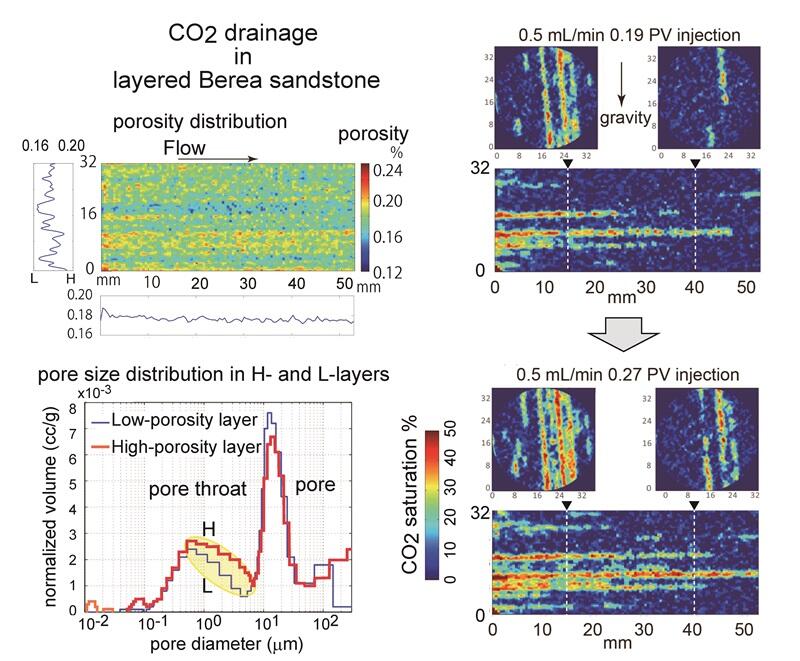
Formation of CO2 flow paths during drainage in a Berea sandstone core
Berea sandstone contains a millimeter-scale structure comprising high- and low-porosity layers. Flooding of CO2 in a Berea sandstone core forms CO2 flow paths parallel to the layers.
Upper left: Porosity distribution, showing high-porosity layers (red to yellow) and low-porosity layers (blue to green).
Lower left: Distribution of porosity volume in high- and low-porosity layers, as measured by mercury porosimetry. The horizontal axis shows the log of pore diameter, and the vertical axis shows the normalized pore volume of each pore-diameter bin. There are two peaks for each type of layer, corresponding to round pores and pore throats. The high-porosity layers have a greater volume of pore throats.
Right: CO2 saturation maps of sections oriented parallel to (lower panel) and normal to (upper panels) the core axis during CO2 flooding. The locations of the two sections in the upper panels are indicated by dashed lines in the lower panel. The core layers are sub-parallel to the force of gravity. The CO2 pathways in the upper panels indicate that capillary force exceeds the buoyancy related to the density difference between the supercritical CO2 and the brine water. Note that pathways occur preferentially in the high-porosity layers. The images depict pathways at two distinct temporal stages, as indicated by the proportion of injected CO2 volume relative to the total pore volume (PV) of the core, with a constant injection rate (0.5 mL/min).
(Figure modified from Zhang et al., 2014: Geophysical Journal International, 197(3), 1789–1807; Caption by NISHIZAWA Osamu and NAKASHIMA Yoshito)
Table of Contents
All the pages PDF : 77_02_full.pdf [21MB]
| Title | Author | |
|---|---|---|
| Review | ||
| Immiscible fluid flow in sandstone: Pathway formation and ganglion dynamics | NISHIZAWA Osamu, NAKASHIMA Yoshito, KOGURE Tetsuya, ZHANG Yi and XUE Ziqiu (p.29-69) | 77_02_01.pdf [15.7MB] |
Abstract
Immiscible fluid flow in sandstone: Pathway formation and ganglion dynamics
NISHIZAWA Osamu, NAKASHIMA Yoshito, KOGURE Tetsuya, ZHANG Yi and XUE Ziqiu
Many types of geofluids exist in the Earth's crust. Geofluids can occur as immiscible two-phase fluids, such as oil and brine or gas and brine. In this review, we present newly identified mechanisms of immiscible fluid flow based on recent advancements in X-ray and computer technologies. Historically, immiscible geofluids have been studied in association with resources such as groundwater, petroleum, and natural gas; however, the research field is also important from a scientific perspective. In recent years, CCS (carbon capture and storage) has been established as an effective tool for mitigating climate change caused by anthropogenic CO2. This has led to experimental studies on the immiscible fluid flow of brine and supercritical CO2 mixtures in porous rocks, in which wetting and non-wetting characteristics control the fluid flow. Water or brine are wetting fluids, and oil or gas (including supercritical gas) are non-wetting fluids in the case of most geologic solids. Wetting results in capillary pressure and controls the flow of immiscible fluids. Rock permeability has previously been considered a primary control on fluid flow; however, recent studies have reported phenomena in immiscible fluid flow (e.g., snap-off and viscous fingering) that cannot be explained by rock permeability alone.
Geological Survey of Japan, AIST
- About GSJ
- Our Activities
- Purchase guide
-
Publications and Database
- information
-
Bulletin of the Geological Survey of Japan
- bull2026(Vol.77)
- bull2025(Vol.76)
- bull2024(Vol.75)
- bull2023(Vol.74)
- bull2022(Vol.73)
- bull2021(Vol.72)
- bull2020(Vol.71)
- bull2019(Vol.70)
- bull2018(Vol.69)
- bull2017(Vol.68)
- bull2016(Vol.67)
- bull2015(Vol.66)
- bull2014(Vol.65)
- bull2013(Vol.64)
- bull2012(Vol.63)
- bull2011(Vol.62)
- bull2010(Vol.61)
- bull2009(Vol.60)
- bull2008(Vol.59)
- bull2007(Vol.58)
- bull2006(Vol.57)
- bull2005(Vol.56)
- bull2004(Vol.55)
- bull2003(Vol.54)
- bull2002(Vol.53)
- bull2001(Vol.52)
- Bulletin of the Geological Survey of Japan(old)
- Annual Report on Active Fault and Paleoearthquake Researches
- Reports, Geological Survey of Japan
- CCOP-GSJ Groundwater Project Report
- CCOP Technical Bulletin
- Cruise Report
- Geological Hazards
- Learning and Education
- GSJ Database Collection
- Collection of links