






Bulletin of the Geological Survey of Japan Top Page
Bulletin of the Geological Survey of Japan Vol.76 No.6 (2025)
Cover Figure | Table of Contents | Abstract
Cover Figure
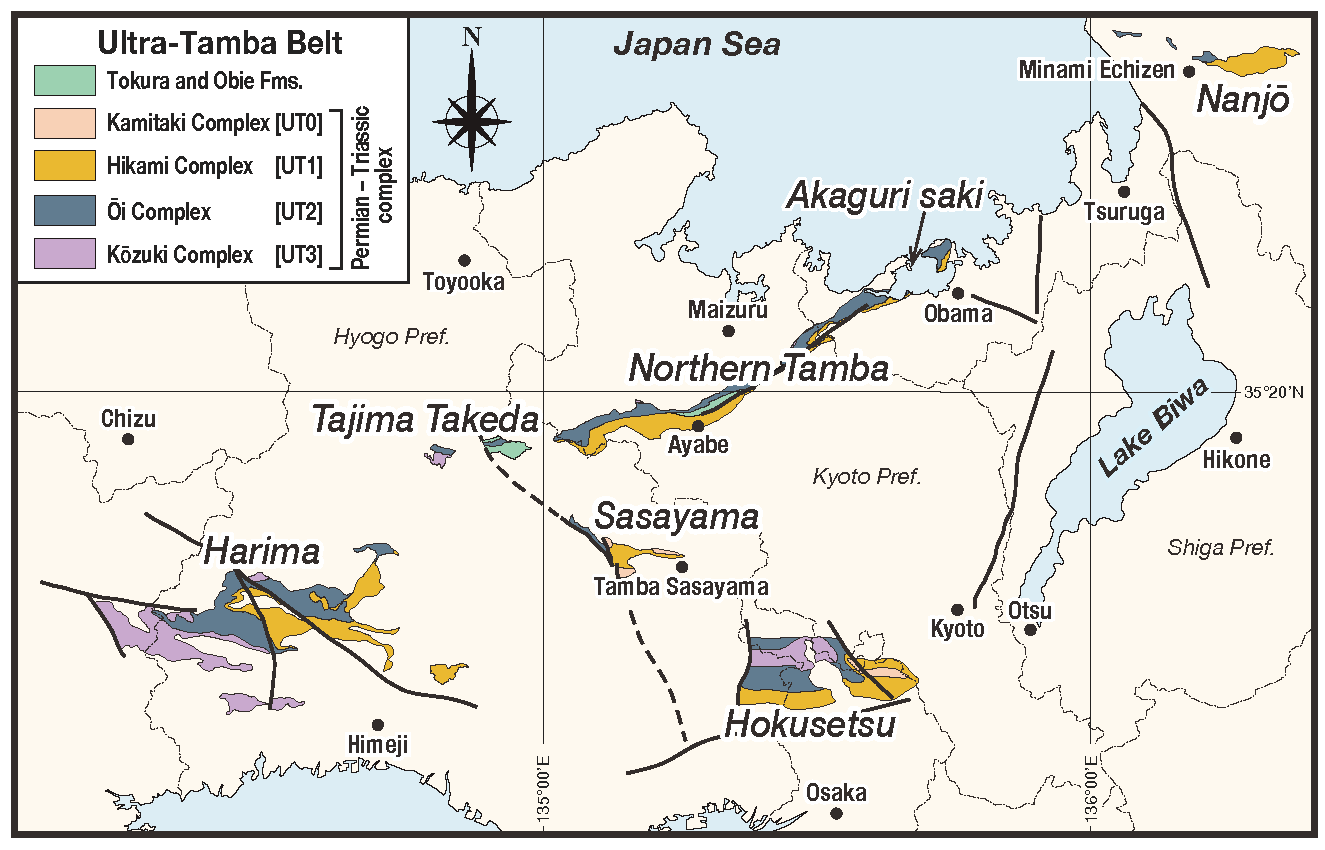
Distribution and stratigraphic classification of the accretionary complex in the Ultra-Tamba Belt, northern Kinki district
The Ultra-Tamba Belt, which consists mainly of an accretionary complex, is a geotectonic unit within the Inner Zone of Southwest Japan. The complex was previously thought to have been deposited during the middle–late Permian, but recent results indicate that its deposition continued until the middle Triassic. This study demonstrates that the accretionary complex can be divided into five types of stratigraphic sequences, each with its own lithological changes. Based on these types, the following stratigraphic units are identified within the Ultra-Tamba Belt: the Kamitaki Complex (sandstone dominant type), the Hikami Complex (mudstone–sandstone type), the Ōi Complex (chert–clastics type), the Kōzuki Complex (mixed rock type), and the Tokura and Obie formations (alternating type). The map on the cover of this volume, which is modified and simplified from text figure 1, shows the distribution of these five units in the Ultra-Tamba Belt, northern Kinki district.
(Figure and Caption by NAKAE Satoshi)Table of Contents
All the pages PDF : 76_06_full.pdf [21MB]
| Title | Author | |
|---|---|---|
| Article | ||
| Categorization of stratigraphic types in the accretionary complex within the Ultra-Tamba Belt, northern Kinki district, Southwest Japan: A transition in accretionary environment | NAKAE Satoshi (p.313–389) | 76_06_01.pdf [21MB] |
【Correction Notice】
p. 333: The garbled "N" character in the compass direction symbol in Fig. 10d has been corrected (3 February 2026)
Abstract
Categorization of stratigraphic types in the accretionary complex within the Ultra-Tamba Belt, northern Kinki district, Southwest Japan: A transition in accretionary environment
NAKAE Satoshi
The Ultra-Tamba Belt, which occurs mainly in northern Kinki district, is one of the major geotectonic units in the Inner Zone of Southwest Japan and was thought to represent a middle–late Permian accretionary complex.
This study re-examined the basis and validity of a previous stratigraphic classification of the accretionary complex from the viewpoints of lithology, stratigraphy, and fossil age. The results indicate that the boundaries of stratigraphic units should be revised in many areas, and that there is uncertainty
regarding the identification of radiolarian fossil species and the ages inferred from these fossils. To resolve these problems, a geologic column was compiled for each study area, and geological surveys, analyses of sandstone composition, and zircon U–Pb dating were undertaken in selected areas, revealing the unique
lithological changes ('foundational stratigraphy') within each stratigraphic unit. Setting this foundational stratigraphy as a basis and standard for stratigraphic classification, five stratigraphic types are identified: sandstone dominant, mudstone–sandstone, chert–clastics, mixed rock, and alternating. Furthermore, the differences among the foundational stratigraphies make it possible to divide the Ultra-Tamba Belt into standard stratigraphic units: the Kamitaki Complex (sandstone dominant type), the Hikami Complex (mudstone–sandstone type), the Tokura and Obie formations (alternating type), the Ōi Complex (chert–clastics type), and the Kōzuki Complex (mixed rock type), from lower to upper stratigraphic levels.
Based on the relationship between the lithologic composition of the foundational stratigraphies and their final depositional age (i.e, accretionary age), these stratigraphies are separated by the Permo–Triassic boundary (PTB) and grouped into older (chert–clastics and mixed rock types) and younger (sandstone dominant and mudstone–sandstone types) groups. The PTB was marked by global climate change characterized by a rapid increase in temperature and a sharp drop in sea level. This change probably influenced pre-PTB and post-PTB subduction to form the two groups of stratigraphic type; however, the causal relationship between climate change and the stratigraphic types remains to be established.
Geological Survey of Japan, AIST
- About GSJ
- Our Activities
- Purchase guide
-
Publications and Database
- information
-
Bulletin of the Geological Survey of Japan
- bull2026(Vol.77)
- bull2025(Vol.76)
- bull2024(Vol.75)
- bull2023(Vol.74)
- bull2022(Vol.73)
- bull2021(Vol.72)
- bull2020(Vol.71)
- bull2019(Vol.70)
- bull2018(Vol.69)
- bull2017(Vol.68)
- bull2016(Vol.67)
- bull2015(Vol.66)
- bull2014(Vol.65)
- bull2013(Vol.64)
- bull2012(Vol.63)
- bull2011(Vol.62)
- bull2010(Vol.61)
- bull2009(Vol.60)
- bull2008(Vol.59)
- bull2007(Vol.58)
- bull2006(Vol.57)
- bull2005(Vol.56)
- bull2004(Vol.55)
- bull2003(Vol.54)
- bull2002(Vol.53)
- bull2001(Vol.52)
- Bulletin of the Geological Survey of Japan(old)
- Annual Report on Active Fault and Paleoearthquake Researches
- Reports, Geological Survey of Japan
- CCOP-GSJ Groundwater Project Report
- CCOP Technical Bulletin
- Cruise Report
- Geological Hazards
- Learning and Education
- GSJ Database Collection
- Collection of links